Teachings on the Bodhgaya Pilgrimage
Parts of this text are translated from the Chinese transcript.
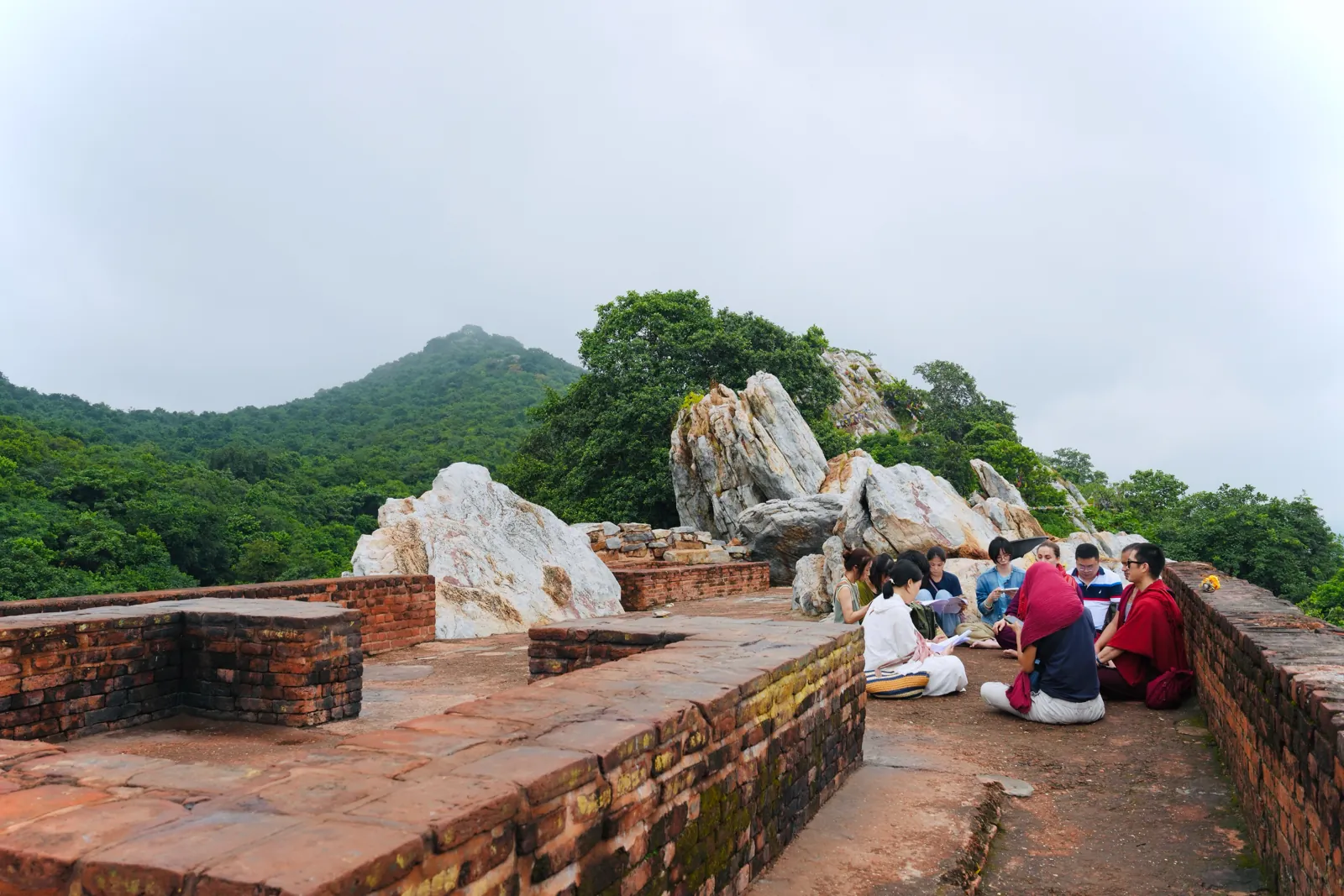
Session One: Before Departure
GarTul Chimi Dorjee Rinpoche | Suvarnabhumi Airport, Bangkok | 2026.09.22
Preparing for the Pilgrimage: Finding Ourselves in Bodhgaya
Before Departure: Make This Journey Your Priority
Bodhgaya, where we are going, is the most sacred place in all of Buddhism. We are not just following along to some place and passing through it; we are also trying to find ourselves in it, trying to connect ourselves with it.
Mentally prepare yourself and prioritize this trip, especially including yourself: "I am ready. Okay, I am ready. I'm ready to absorb all the blessings and all the beautiful, very precious stories." Of course, from time to time you need to deal with your friends and some work-related things. You can do that, but prioritize this trip, day and night.
You Are the Root of Everything
This is the most important point, and it is also what I notice sometimes: when we read a book or visit some holy site, a holy place, anything, sometimes we forget about ourselves. For your life, you are the center. You are the root of everything.
Blessings need to connect to yourself. The teaching, the Dharma, also needs to connect to you, just like all the doctors and all the medicine are somehow connected to yourself. Therefore, we really need to find ourselves. This is the key.
Forgetting Ourselves: A Mind Drawn Away by the Surroundings
We are missing that point. It's just like right now when we cross by: you forget yourself. You are attracted to and affected by the surroundings. Whatever you're doing, you immediately think, "Oh, this and that," and you lose touch with yourself.
Session Two: Evening Talk Before Setting Out
GarTul Chimi Dorjee Rinpoche | Bodhgaya, India | 2026.09.23
The Moment of Enlightenment: Reflecting Our Own Awareness in the Buddha's Three Levels of Qualities
Witnessing Enlightenment: The Greatest Moment for All Humanity
How fortunate we are, how lucky to witness the moment of the Buddha's enlightenment here. It's just like coming out of the dark age, when the sun starts to bloom. It is a great fortune for countless sentient beings.
Tomorrow is so important because this is the place where the Buddha finally bloomed and opened that nectar. It's just like the honey is ready. This is one of the biggest celebrations and the biggest moments of all humanity.
I Take Refuge in the Buddha: A Person Ripened Inside and Out
Tomorrow there is also a direct connection, the so-called "I take refuge in the Buddha," the essential refuge. The Buddha finally ripened here: a person who is fully ripened both outside and inside, ready to eat, ready to offer. This is the essential quality.
Before his enlightenment, he was never called the Buddha. He was a practitioner, dedicated day and night, trying his best. But finally he was completely ripened, ready, enlightened, so-called awakened. It is not about the outside; the person is the one who has that inner quality, the root essential qualities.
When we talk about the enlightened, awakened one, we are talking about the secret of the Buddha himself, and this is the time when he became complete. That is a person whose inner qualities are ripened and complete, right down to the root.
Outer, Inner and Secret: The Three Areas of the Buddha
So there are three different areas in the enlightened one, the awakened one, the so-called Buddha, and we are able to witness these three different areas of qualities: outer, inner and secret.
When this comes to you yourself, it is actually a big gift. When we look at the Buddha now, we are able to see three different paths, three different areas, and through that it can also give you a reflection. Just like when you look in the mirror, you are able to see yourself, your own state: "I am also not one-dimensional. I also have an inner dimension. There is also a secret area. Oh, I also have that power."
This moment, this whole complete version of the Buddha, immediately gives you three areas of yourself, three parts of yourself.
The Ultimate Refuge: Understanding the Awakened Qualities
This is the ultimate refuge itself. We need to know that. What exactly is that awakened quality? What exactly are we talking about when we talk about refuge, and what exactly of it is part of us? It is very important to understand the awakened qualities.
If we know that, then our practice, our approach, always has a guaranteed future. Otherwise, if we have no idea what exactly the awakened qualities are, and out of the blue we are expecting, hoping, and getting involved in many different activities, the fruition is not really guaranteed.
As I said, when we can understand the Buddha's three levels of qualities, we know what the awakened one, the Buddha, really is, and true refuge arises from that. Understanding the Buddha's three levels and recognizing our own three levels: this understanding brings true refuge.
Body, Mind and Awareness: Reflecting Ourselves in Awareness
The body, the mind and the awareness part: three different areas. The awakened quality is the awareness itself. So when we look at the Buddha, you are able to reflect yourself in the pure awareness zone, that part of you.
I just want to give you a hint, because we already discussed this. If you want me to go over body, mind and awareness again clearly, then tomorrow you can ask anytime and we can talk more about it. But as a general reminder, since we've already been through it:
Part of you is very much disturbed by the outside world, the sensual world, not even enough in touch with your own body. And there is also a mind, and there is also awareness. There is awareness. So when we go to the temple, you are giving yourself a chance, allowing yourself to rest in the awareness zone, and to receive the energy, the blessing, trying to feel it.
Buddha means, enlightenment means, that Buddha nature, that awareness zone. So it helps you to reflect yourself as you try to receive this energy, this blessing.
Taking Refuge in Our Own Awareness: Giving It More Time
The Buddha's pure awareness is the enlightened quality, and that part is dominant in his life. Normally, for us, that part is missing. But when it comes to taking refuge from our side, it's about our awareness. We are taking shelter in part of us, the awareness which is already part of us. We are trying to give more momentum, more time to our own awareness. This is the proper approach to the ultimate refuge itself.
The enlightened quality is the Buddha's pure dominance of his own pure awareness. As a self-reflection, try to allow yourself to rest in your own awareness zone, and receive and draw in the blessings toward yourself as much as possible.
Tomorrow Under the Bodhi Tree: Connecting with the Buddha's Awareness
If we have the sadhana text tomorrow, we need to find a circle outside to recite it together. If we cannot prepare the sadhana, then we can go directly inside, near the Bodhi tree, and just meditate silently there.
Try your best to engage that enlightened quality of the Buddha, his pure awareness, and try to link and connect your own pure awareness to it. If you feel more disturbed, you can go a little further and circumambulate the stupa, then try to settle yourself again.
The Last Three Nights: Respecting This Place, Respecting Ourselves
We still have three more nights. Try your best, no matter how busy you are. You're already here, so try to give respect to this place, respect to yourself, and draw in the blessing as much as possible.
It doesn't necessarily mean forcing yourself. It doesn't necessarily mean cutting your ties; we can keep doing things. But a gentle reminder: "Okay, these three nights, I'm going to give respect. Respect to myself, respect to this place."
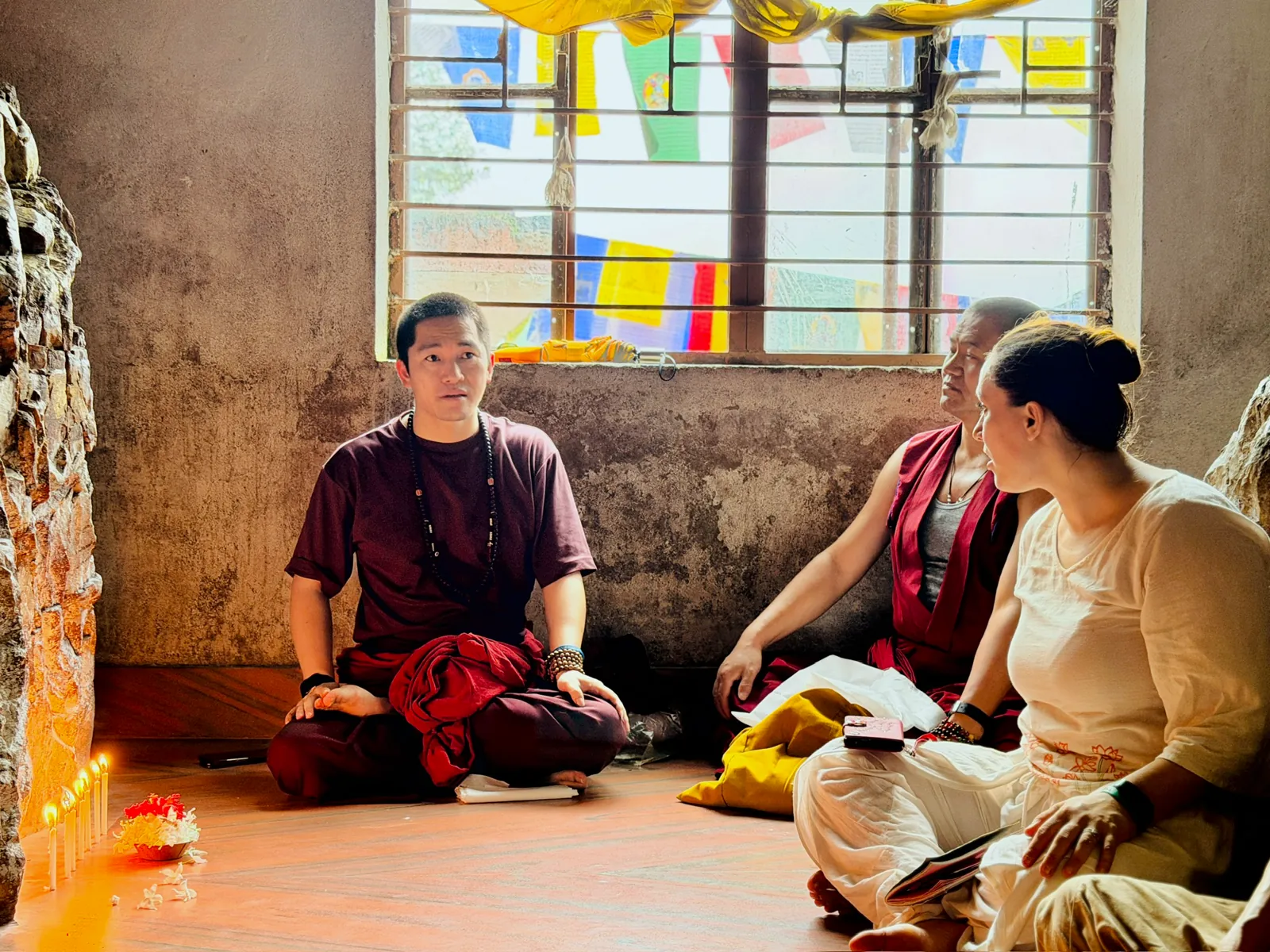
Session Three: At the Cave of Austerities
GarTul Chimi Dorjee Rinpoche | Cave of Austerities, Bodhgaya, India | 2026.09.24
Lessons from the Cave of Austerities: Truly Wanting, Effort and the Right Way
Savaripa: The Instantaneous One Who Appeared as a Hunter
This was also where Mahasiddha Savaripa practiced, a practitioner of Samvara and of a well-known Avalokiteshvara sadhana. I don't know if you can see it, but the Indian government is controlling this place now.
I also suggest you read the story of Savaripa. It is not a very long story. He was a direct disciple of Arya Nagarjuna. Savaripa is also known as the junior Saraha, and Saraha is one of the great masters. Each of these mahasiddhas has a unique appearance: just as Tilopa appears as a fisher, Savaripa appears as a hunter.
Among the students, there are gradual ones and instantaneous ones. Some students require a gradual process; they really need those gradual practices. But Savaripa is among the instantaneous.
Besides that, Savaripa also had two sisters. They were beggars, going around begging, and they met Nagarjuna together. Arya Nagarjuna gave them a direct instruction of Mahamudra. After that, Arya Nagarjuna knew that he was an instantaneous student. So he is one of the symbols of the instantaneous type of student.
Nalanda University is around 80 kilometers away. There is also the cave of the Dharma protector Mahakala.
The Place of Austerities: The Buddha's Six Years of Practice
In Chinese Buddhism, especially based on Xuanzang's documentation, this is recorded as the place where the Buddha practiced for six years. The local people prefer other accounts, and it is argued, but based on Xuanzang's record, it is here. We can also do some research.
The story cannot be as simple as that. Six years in our lifetime, with day and night dedication, is not as simple as how we can tell it. This is a historical proof that the Buddha is not just someone who wants something.
Wanting and Effort: How Serious We Are About Our Lives
Nowadays, here is our problem, which we can all relate to: everyone wants something. We like to have a big dream, to have many things. But when it comes to putting in effort, the effort is no longer there, especially in the younger generation.
Everyone wants to be happy, everyone wants to be free, wants to have this and that, but for that it takes your effort. If you are not very serious about what you really want, if you are not really seeing the value, you don't want to do anything at all. That is testing us: how serious we are about our living.
The Buddha himself is a living proof that he wanted something, and not just with prayers and wishing. He practiced until he was like a skeleton, skin and bone alone, at this kind of level, with many different practices, not just fasting alone; there were many different ways of doing it.
Wanting plus effort: our effort is the proof of how much value we are putting in, how much we really want it. That's one big message.
Beyond Effort: The Right Way
But there is also another side of the message. Even though you want it and you put in such an effort, as the Buddha put in six straight years, working very hard, and he really wanted it, without the proper instruction, good proper guidance, the right way, wanting something and working hard is not necessarily what gives you the fruit. Hard work plus the right way.
But still I believe: not just wanting something; if you put in an effort, no matter how wrong it is, maybe this effort may not give you a direct result, a direct benefit, but it will indirectly lead you to find the right way.
Cherishing the Teachings: Our Good Fortune Comes from Another's Hardship
Therefore, we are so fortunate and very lucky. In our practice, we don't need to put in effort the way the Buddha did. For him, everything was hardship. Through it, the fruit he attained has come to us.
It's just like sometimes kids never appreciate how the parents put in their effort and hardship to bring the food onto their plate, and this house that they have built.
The teaching is already present, very mature, very friendly. Therefore we really forget; everything seems so simple, so clear. We may not feel someone's lifelong dedication. There were thousands of people who tried and attempted to find this, but never reached it.
The Buddha is one among the millions. Throughout the entire community, he is the first person who was called the Enlightened One. There were many practitioners during that time, but the Buddha was the first one who was socially accepted and called an enlightened being in the form of a human being: the awakened one, the enlightened one. Before that, there was worship of this and that, many things, in the form of gods, in the form of this and that.
A Monument of Compassion: Giving Authority to Yourself
But on top of that, we are so fortunate, so lucky, because he is a monument of compassion. He really wanted to offer us total freedom, no compromise.
The teaching of the Buddha is aimed directly at you. He is giving authority to you, to yourself: your wisdom to yourself, and your compassion to yourself. He is directly giving authority to yourself.
He is not there to receive your support or to receive something from you, because for him personally, he is freed and liberated. This is the greatest sign: he only has compassion for us. Those who need something from you are aiming at you; they give something, just like fishing: give something and take it. There is a compromise.
Throughout history, if you really look at the teaching, especially the framework of the Four Noble Truths itself, isn't it so? Everything is here, but we are unable to see it.
The Dharma Is the Law of Nature
Sometimes we say that Dharma is so difficult, because it's too close. You cannot see it, and we have a habit of running around. But sometimes we say Dharma is the easiest, not difficult at all.
When we talk about the Dharma, Dharma is not some sectarian belief. Dharma is simply the law, the rules of nature. We need to know those facts, just like gravity can pull you down, and fire can burn you.
If you want to follow the genuine idea and exact approach of the Buddha, you really need to take direct authority from yourself, because there is no one who can feel yourself better than yourself. There is no one who can see all the details of your thoughts. Whatever you are thinking, others are never going to see it.
And the way you feel, the way you see: you are together with yourself 24/7. You are the best candidate, and the authority. You need that complete and total authority over yourself. With the principal understanding of the Buddha's teaching, now you need to be the one.
I truly feel that, with this kind of genuine talk, now I need to do better myself in everyday life, in my life, in the way I experience. From your side, you also need to do that, both from the teacher's side and the student's side. Set the life standard higher, including our health.
I truly believe we are very, very fortunate to receive all the teachings and to be one of the followers of the Buddha himself.
Learning from Angulimala: Having a Teacher Without Compassion
Or else, there are many cases, especially among the arahants, who have very bombastic, hectic stories connected to them. There is one arahant who nearly killed a thousand people: Angulimala. If you see his story, you will understand.
Even simply being a lover of the spiritual, of the Dharma, you really want to give everything in life and follow whatever is offered. But once you are so ready, it is necessary that we give this kind of clear instruction and total authority.
Angulimala's story is one of the proofs. He nearly killed a thousand people because of his master. His master told him to do that. And why? Because of the lack of empathy, the lack of compassion of the master.
And why did the master do that? Angulimala, since a young age, was physically very strong, intelligent and very brave. He was attracted to spiritual practice. He followed a master, and he did whatever service the master asked him to do.
During those times, receiving a teaching was not like nowadays, immediately a PDF. For that you needed to suffer for one year, two years; you even needed to put your life at risk for these kinds of things. But whether that teaching had a benefit or not, it was just like a blind poker game, a card game; it tested your instinct, that's it.
So he followed one master. I also suggest you read that story to understand the whole picture, but I will try to make it short.
One time his master went away for some important reason. The master was a family man; he had a wife. The wife was attracted to the young Angulimala, and she tried to persuade him. But he was completely dedicated, with faith and devotion to his master: "No, impossible. This is impossible. You are like my own mother, because you are my master's consort. Impossible."
Then, when the master came back, she cried in front of the master, and the master felt very angry. But Angulimala was very strong-willed and very brave; physically, the master could not do anything to him.
So the master waited and gave him some small instructions to complete: this meditation, that meditation, this practice, that practice. Then at the end, he waited for that moment and said, "Okay, now I have a final instruction for you. If you follow it, there is nothing more you need to do. You have guaranteed liberation." The instruction he gave was to kill a thousand people and complete a garland of fingers, cutting one finger after each killing. Once it was completed with the thousand, there would be instant liberation.
The Bird's-Eye View: Following the Dharma Is Not Blind Following
I want you to focus on the general picture, the bird's-eye view, the overall understanding, and also on the details. Or else, sometimes we get lost.
In this way, in this attitude, if we really follow the Buddhadharma, your common sense is always working, your thinking mind is working. It is not that you take it and blindly follow. This is the gift.
Your thinking, your eyes, your breath are one hundred percent allowed to function. And your emotions, you are fully allowed to use them, everything about us.
What we are talking about is taking the limited mind into the limitless. It's like an expansion, like an extension. Life is not just something little and tiny, like an ant. You are not just a bubble. You are the entire universe. This kind of expansion, this kind of quality, is there.
Grateful and Happy: Following the Instruction, Taking Care of Ourselves
In actual practice, be grateful, be happy, just like a grateful and happy kid when the parents offer good food and clothes and things. And follow the instruction. If you really follow the instruction, the more you use this brain, the sharper it gets.
So feel grateful and always take great care of yourself. This is the practice here.
Life Sensitivity: An Artistic View
Set a higher standard for yourself, with the life connectivity. Follow the instruction, find your life energy. Set your standard higher, which means life sensitivity; I'm not talking about the heroic and selfish kind. With that life sensitivity, you know how to handle yourself better, and you learn how to enjoy more.
It's just like an artistic view. I really like that idea in normal language: artistic view. An artist means bringing value out of ordinary things, just ordinary things. It's just like a photograph: you see some small, simple leaf, and you make it very beautiful. Just like that. We really need this kind of art.
Harmony of Body and Mind: Remembering the Buddhas and Accomplished Masters
At the end of the day, we are the ones who are dealing with ourselves every day and night. My body is giving me lots of trouble, and my mind is also giving me trouble. I am the one who is dealing with myself. And the Buddhadharma is how to handle yourself better.
Especially when we talk about the body, mind and awareness, it is bringing harmony between the body and mind. If your body and mind become one, you will be able to bring harmony.
Bring to mind all the Buddhas and accomplished masters: their aspiration, their dedication, their energy, their compassion, everything. Just try to feel their presence.
Session Four: Dinner Talk
GarTul Chimi Dorjee Rinpoche | Bodhgaya, India | 2026.09.24
The Sources of the Mahayana: From Vulture Peak to the Quintessence of the Three Vehicles
The Sources of Language: Sanskrit and Prakrit
There is some Prakrit; Prakrit is a language. Within Sanskrit there is a lot of Pali and Prakrit, so Sanskrit is kind of a hybrid, something mixed. Sanskrit became very much predominant, but the origin is still there.
There are many debates, and the research is still going on. It wasn't really that way. With time, they crystallized it into something, but that wasn't how it was originally. They made it.
Vulture Peak: The Prajnaparamita Sutras and the Heart Sutra
But it is very interesting to discuss when it comes to Mahayana, because tomorrow we are going to visit Vulture Peak. Vulture Peak is one of the most famous places. The Heart Sutra is the essence of the Mahayana itself. I think Vulture Peak is related to the whole Prajnaparamita cycle, with the Heart Sutra as its essence.
A Milestone of the Mahayana: The Importance of the Mind
If you really come to the sense of the practice, there is a great milestone here. When we talk about the mind, Mahayana is dominantly and very much emphasizing the mental factors, the importance of the mind. And that's Mahayana.
The path became something completely different, a different class. And it influenced many places all over the world, like China, and during that time Gandhara, and universities such as Nalanda. Everything about the Buddhists was talked about worldwide. Nalanda is one of the places we got the entire transmission from.
Conflict Within: Buddhists Fighting One Another
Mahayana also literally became a new trend, something every practitioner was talking about. But within our society there was a big clash. The ancient Buddhists fought within our own community. Within the Hinayana, the Theravada, there were eighteen, twenty, many different groups. They really didn't accept one another: "Mine is pure, mine is original," or something like that.
And when an approach out of the box came, Mahayana, they said Mahayana is not the Buddha's teaching at all. And the refined, distilled version of the Mahayana comes to our Vajrayana, and they even said that is not Buddhist; the Vajrayana is also not the Buddha's word. But every one of us claims ourselves Buddhist; we are all taking refuge in the Buddha, Dharma and Sangha.
Back in that time, we were not fighting with something external, apart from the Buddhists. It was actually within the Buddhists. So there was a big conflict and a big downfall, we can say, that happened.
India: The Dharma Spread Throughout the World
Everything about India, if you really look at it, is not just within India. The Dharma influenced the whole world; it spread from India to many different places. Everything about the culture, the history and the special features of India is somewhat like the Buddhadharma itself. There are lots of things.
The Good Fortune of the Vajrayana and the Quintessence of the Three Vehicles
For my whole life I have been completely exposed to the Vajrayana tradition, so-called deity yoga, so-called Vajrayana. I and many Tibetans, and all of you also, got cultural exposure. And this is our fortune, our luck, our good karma, our good merit, that we are in it. We were born into it, or somehow we have a very deep connection with it.
But essentially, though we are completely cultured in this Vajrayana and got exposed to it, when we talk about the essential practice, the quintessence: Vajrayana deity yoga practice is the quintessence of the Mahayana, and Mahayana practice is the quintessence of the Hinayana itself.
The Four Seals and the Four Foundations of Mindfulness: Everything Is There
If you try to follow the four seals, the Buddha's four seals, and even the fundamental meditation practice such as satipatthana, mindfulness meditation, which we call the four foundations of mindfulness, everything is there. There is body observation, there is feeling observation, there is the so-called mind observation, and through that, phenomena.
And the four seals are also the essence of satipatthana itself, of shamatha and vipashyana, because you begin to see that everything is interrelated, connected, of an impermanent nature; impermanence literally happens within everything. Do you get it? This means it is clearly emphasizing emptiness, shunyata.
Whatever Mahayana is talking about, it is talking about these things, which are widely accepted in India, culturally and practically.
Session Five: Evening Teaching
GarTul Chimi Dorjee Rinpoche | Bodhgaya, India | 2026.09.24
Body, Mind and Awareness: From Body Sensitivity into the Mahayana and the Mandala
Entering Through Body Sensitivity
We need to enter with body sensitivity. Through your body sensitivity, you are learning for yourself how your mind is literally affecting all of you: your energy, your emotions, your health, your body's stress and tension.
They talked and talked; they saw in great detail the entire function and characteristics of the mind: the essence of the mind, the function of the mind, the characteristics of the mind, as karma, cause, condition and effect. Dependent origination: everything is correlated. There is no such thing as inherent existence.
Then that essence of emptiness comes, where you feel completely free. The mind is never stuck in time and space. And that very essence comes to deity yoga.
Back to the Fundamentals: Bringing Our Life into Practice
For us, culturally, we are exposed to it; we are doing it. But essentially, if we are really practicing with our own sense, our own experience, I also need to go back to a fundamental practice: through my body, through my sensations, through my feelings, now I can relate. In deity yoga practice I have that problem: we are unable to relate our life, our self, to the practice.
And we start to imagine, we start to expect: "Oh, this is powerful, this is powerful," or something like that. But the so-called essential instruction is there, very pure, very clear, very nicely put. If we really follow it, I need to know my own mind in more detail, and all these things about the mind are based on the sensitivity of my body, my own life itself.
Once you change your mind, you can see it immediately; you can witness yourself. Your energy is changing, your emotions are changing, many parts of us.
Body, Mind and Awareness: A Summary of the Dharma
When we try to summarize all the teachings of the Buddha, it only talks about three parts: body, mind and awareness. Sometimes we are losing ourselves, and sometimes we have no idea where we are. But if you really look at the summarized version, there is the body part, the mind part, and the awareness part.
It is such a beautiful thing when we talk about this mind in a practical sense. With very much observation of the body, through this practice the body becomes extremely sensitive. Through that we are able to track it: your mind thinks a little bit, and you can immediately know.
In that zone, we are at the second zone, one step behind the awareness. At the end of the day, the study of the mind, the study of the Mahayana, is coming back to you, falling back to the background, the true nature, as we call it. As awareness, it is one step closer to the ultimate reality, the ultimate truth. It is like we truly hit the milestone.
The View of the Mahayana and Bodhicitta
I wanted to link that historical place to a practical sense, and especially to bring the terms closer, because the so-called view of the Mahayana, the class of the Mahayana, is something very big. Sometimes we are unable to see it, but it is related to the so-called body and mind. It is about the mental area, the mental features. And through that, the method of finding the true reality is the view.
But then there is the practice of kindness and compassion, the so-called bodhicitta. Because we are interrelated, like a linked relation, it is not just for ourselves: whatever I see, me and this entire ecosystem have a personal relation. And for you, your own entire ecosystem has a completely different reality.
The Mandala: Completing the Mandala Is My Responsibility
We are saying the essence of the Mahayana is the Vajrayana itself. In the Vajrayana we talk about the mandala.
I and the entirety of the world, whatever I am experiencing: we are in the same Bodhgaya, but the way I feel, the way I experience it, is completely different. You have your own version, I have my own version, and everything I experience has my own thoughts and thinking; my own involvement is there.
With that involvement, me and the entire ecosystem, my body, my mind, my awareness, and this whole ecosystem have some connection. The mandala also has four different levels: outer, inner, innermost, and so on. It is that kind of thing: I should be the one who can really complete the whole structure of the mandala. This is my responsibility.
Vulture Peak: Feeling the Blessing of the Whole Mountain
Anyway, tomorrow is Vulture Peak. That place itself has such history, and we have already repeated that place name more than a hundred times, a thousand times. There, by the blessing of the Buddha, the exchange between Shariputra and Avalokiteshvara Bodhisattva happened, and the great, famous Heart Sutra happened there.
But what do we do when we go there? There is one actual ancient ruin, and many people go directly to that location. But I don't think it is only that place, that ruin of the house people go to. What I want you to do is try to feel this entire mountain, anywhere, anything, because this entire place is blessed. But we need somewhere to go, so we also go there.
Nalanda: Focusing on the Qualities of the Mind
Nalanda: there were many great masters there, thousands of them, and a major worldwide influence. Many important practices came from there. Nalanda truly produced the qualities of the mind, many great practitioners, and worldwide influence.
Interpreter's note: The second place tomorrow is the ruins of Nalanda University. Our Xuanzang also went to Nalanda to study the Yogacara (Consciousness-Only) school with Shilabhadra, and then brought the whole Yogacara teaching back to China. Shantideva was also there, and The Way of the Bodhisattva also comes from there.
About the person who destroyed Nalanda: they are blaming one of the kings, one of the Muslim kings, whose origins are actually connected with the Afghans somewhere. But many historians don't buy that narrative. There are many stories, because they wanted to blame everything on the Muslims, but inside there are many stories.
One thing I truly believe: within the Buddhists, there was exclusion, saying the Mahayana is not part of Buddhism, or the Vajrayana is not part of Buddhism, or something like that. A big thing was happening, and during that time many things happened. We cannot say exactly. And I don't think those stories can give us any positive influence.
It is better to focus on this place, where it could produce such qualities of the mind for many important masters. Let's stick with those qualities. And if, as a personality, you have an extra interest in those histories, then try to find out from many different sources. Because I also don't buy that a Muslim king could come and burn it or something.
Session Six: The Buddha's Sensitivity and Our Good Fortune
GarTul Chimi Dorjee Rinpoche | Bodhgaya, India | 2026.09.27
The Buddha's Sensitivity: Why One Born with Everything Set Out
The Child Who Wept at the Food Chain
The Buddha himself was a very sensitive kid, a very sensitive person. When he noticed the food chain, he cried. Who keeps going to see the food chain? They aren't even able to see the food chain. We aren't able to see the food chain. We don't have that emotion.
A bird eats the ant; he had that over-sensitivity. The bird is eaten by a bird, and by another bird, and he kept looking and following the birds, until the sun was finally up.
We Are Luckier Than the Buddha
We are luckier than the Buddha himself. But we are less fortunate than them, of course. It's just like ungrateful kids. With good parents, some bad kids come. But some kids with a very difficult life become even wiser and stronger, and some kids who are very fortunate become more useless. It's exactly the same if you look at Buddhism.
He was less lucky than us, because he didn't have clear guidance at all. He needed to walk and find, even though he was so sensitive. He appreciated all the teachers, but he was not getting the things that we are getting from the Buddha directly, the enlightened one and awakened one.
There were many teachers, but he knew when to say thank you: when to say hi, hello, thank you, to show appreciation, and also when to say goodbye. Not forever stuck there. Because he didn't have any weakness, because he was born rich, with many things, his goal was very clear: not to get stuck by anything.
Or else, a little bit of money comes, you feel excited, happy, and you stop there. A little bit of power comes, and you can also stop there.
Therefore, we are very lucky. The Buddha had everything: money, youth, whatever physical needs, the pleasures of all five senses; everything he needed, he had. Therefore he still sought that one thing: mental freedom, mental clarity. Therefore we are luckier than the Buddha himself. He didn't have it, and he went.
Freedom Is Still in Our Hands
But the very great thing is, we are very grateful he was born rich and born with everything. Therefore he saw the value of life and kept looking, and he never stopped. Social praise he already had from his childhood; praise, respect, everything he already had. But he needed that inner connection of mind and body, that freedom. He walked very hard. And finally we have it. Just like an ungrateful kid.
We are very lucky. We have such precious parents. The Buddha doesn't want to control us.
Therefore, one of our biggest problems is this: sometimes we like somebody to follow, we like somebody who can control us. It feels like, "Oh, they're powerful, they're something." Somebody gives us freedom, and it feels like, "Oh, maybe..." We didn't see the value of action, the value of having freedom still in our hands. We didn't realize that.