Autumn 2026 Nyiné: Teachings on the Eight Precepts
Day One: Morning Teaching
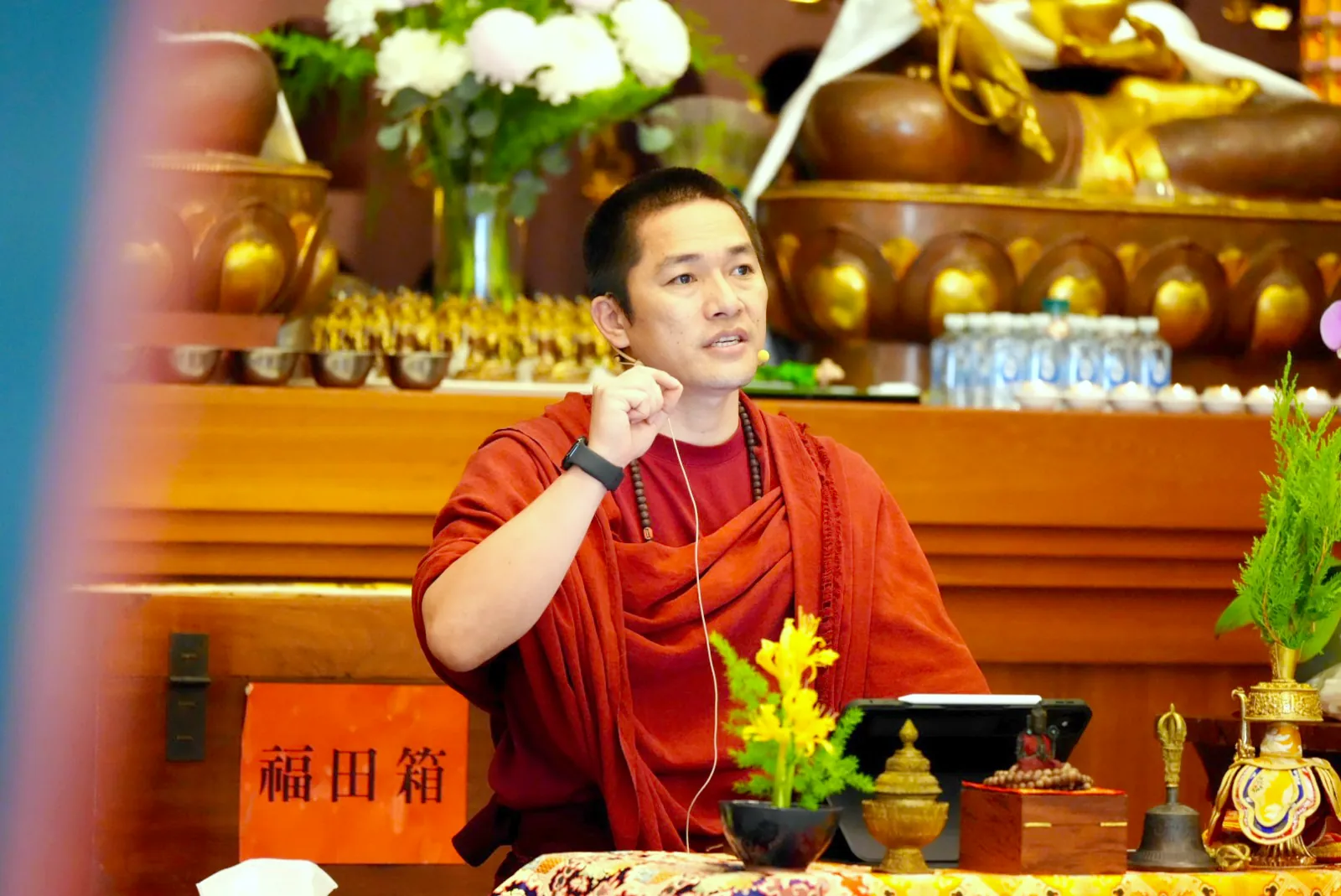
GarTul Chimi Dorjee Rinpoche | Huayu Center, Banqiao | 2026.10.10
The Chenrezig Practice: Through Body, Mind and Awareness to Refuge, Bodhicitta and the Deity
Back at This Place: Gratitude and Blessings
Good morning. And to the Dharma masters of this temple, have a blessed National Day. Today is National Day.
Let me begin with all our organizers and volunteers, every one of you who has put your heart into organizing everything. I'm very happy to be back at this place. I remember the first time I came here, about five or six years ago, with His Holiness (editor's note: Drikung Kyabgon Chetsang Rinpoche), alongside many true good friends. At that time the Dharma master of this temple also visited, and we had a short heart-to-heart dialogue, and there was the oral transmission from His Holiness. It's been a while, but I'm really happy to be back in this wonderful and beautiful place.
I also want to show my respect and appreciation to the Dharma master of this temple for providing us this wonderful place for the practice. And especially our sister: she is the one who helped us take care of everything in this place so that we can practice.
Are You Ready? Put Yourself First in Practice
As you can see, the place is ready, and the preparation is ready. Now there is one thing: are you ready? Now it's all up to the practitioner. You need to be ready.
The most important part of the practice, we need to know this. There are many misconceptions and many misunderstandings: this practice is a great one, this practice is a powerful one. We are running after this kind of greatness and this kind of profoundness of the practice, excluding ourselves. But realistically, if you want the effect of the practice to happen within you, the key is you yourself. So you yourself should be the first priority.
The practice is there for you to connect. Every practice is full of instructions; it is there for you. So I want every participant, every practitioner, to prioritize yourself. No matter how high the Dharma, this book and these practices are, don't get completely lost in them. The missing part is you. The Dharma is here to reconnect you and refine you.
Relaxation: Sensitivity to Yourself
So let's begin with yourself. What I want you to do is feel yourself and try to relax, okay? Try to connect with yourself, and from the very beginning try to relax yourself as much as possible. That relaxation must be there from the very beginning of the practice, during the practice, and after completion, which means that through the entire cycle of the practice, that relaxation must be there.
When I talk about relaxation, what it means is self-sensitivity. You are the one closest to yourself, but sometimes when we practice, we lose ourselves in reading these things. Closeness towards yourself is another part of that self-sensitivity. Remember, everything you are reading must be applied and must happen to you; it needs to be felt within yourself. So that relaxation will give you sensitivity and a much closer distance to yourself.
Body, Mind and Awareness: The Three Parts of Practice
Another part about you: most of the students here are our old students, and we have simplified and summarized the ideas of the practice and put them in the frame of body, mind and awareness. Your body: you need to have that sensitivity of your body. And mind: you have different types of mind, I have many different types of mind, but here it is the mind which belongs to you, which is disturbing you, which is making your emotions go up and down. And the awareness. Those three parts of you, you need to acknowledge.
No matter how much you practice and whatever practice you do, even if you go through a hundred different books, reading them and learning them, when it comes to practice, it is directly about body, mind and awareness. Make it very clear to yourself, okay? When we talk about the body, it is the body that you have. Every one of us has a unique, different body. So it is exactly the body which belongs to you, the mind which belongs to you. And awareness is always present, but in our ordinary days it is not yet present to us, though it has always been there.
So purification is needed within the framework of your own body, and mental purification is of the mind which belongs to you. Within that framework you need to organize, you need to purify. And the awareness, the hidden awareness, is just like the sun blocked by the clouds. We are very busy, the mind is running here and there, so awareness is never really present to us. But that doesn't mean it doesn't exist; it's always there. So you need to understand those three parts of you: your body, your mind and your awareness. All the practice comes back to the presence of your own body, mind and awareness.
The Chenrezig Practice: The Deities Are One in Essence
It is within this framework of your body, mind and awareness that this wonderful, profound practice works. Today we are going to do the practice of Chenrezig. And when we talk about the Chenrezig practice, we also have a very special way of practicing. Chenrezig is a deity; this is the practice of a deity.
The Chenrezig practice is not separate from the other deities. I also want to make this point very clear: the Chenrezig practice is no different from the other deities. For us, when we talk about the deities, every one of the deities is true and in the right form, and the essence of all the deities is exactly the same.
With that knowledge, if you follow the Chenrezig practice as a deity practice: deity practice has its own significant approach, its own root, with some principles there. With those principles, if you look around, you can feel that in the Chenrezig practice you are practicing the typical deity practice, and in the practice you are able to see its connection with all the other deities.
The Lineage of Gelongma Palmo: Three Vehicles in One
So the Chenrezig practice is a deity practice; the main practice is the same. But especially in this Chenrezig practice we are following the lineage of Gelongma Palmo. She has her own special connection with Chenrezig, and she was a long-term, dedicated practitioner of Chenrezig. So it is the same as the general sadhana, but with some additional content: she wrote some beautiful aspirations, like a praise to Chenrezig.
And in her approach, she has clarified this very well. This practice has very special qualities, which highlight the entire combination: we can say the Hinayana, the Mahayana and the Vajrayana, the three combined together.
If you look at many of our other texts, they are also practices with the three combined together; every deity is like that. But somehow we are always rushing. We read the refuge very fast, very fast, then jump directly to the deity and the mantra. But she tries to make that process very careful and very detailed, so that people can easily follow it. It's just like putting a highlight, a very clear and detailed highlight.
Refuge, Bodhicitta, Deity: Linked in Sequence
As you can notice, when we refer to the three, especially the deity yoga: the actual practice of the deity is the deity yoga. Before that there is bodhicitta: we receive a vow for the benefit of all mother sentient beings, in order to attain the enlightened qualities. That is the Bodhisattva vow. Besides that, physically we are trying to protect the body. And there is the refuge part. Sometimes we take the three separately; many of us have that misconception. But the three must come together, through the process of the growth of our own pure awareness.
So everything begins with the refuge, okay? The deity yoga that we are doing is the essential quality; it is a refined version of your own state of mind. And as you have heard, in order to receive a deity practice, you must first go through bodhicitta; we need to have the bodhicitta vows. And in order to receive the bodhicitta vows, you also need to go through the refuge first. So in this framework of the practice, refuge, bodhicitta and the deity fit very well with the framework we just discussed: body, mind and awareness.
Refuge and the Body: Harmonizing Body and Mind Through Meditation
When we follow that structure of refuge, bodhicitta and deity yoga: as the body, refuge is like the Hinayana tradition. If you really look at it, everything begins with meditation, right? And meditation means the sensitivity of your own body; you are bringing yourself closer to yourself. With that proper sensitivity, you know whether your body and your mind are in order together. Once you are connected with your body, you know that your mind running to little things here and there is making you feel more exhausted, more tired. So you also need to harmonize the work between the body and the mind.
Once your body and mind are somewhat aligned and harmonized, the presence of your awareness will be much easier, and you will be more aware of yourself. And with that clear sense and deeper sense, you can feel that now it's all right here, right? You can also regenerate and purify your energy much better.
Bodhicitta: Compassion Spreading Its Wings
And after that, as a gradual process, now the bodhicitta practice comes. With that very deep level of self-sensitivity, it's not just about calming down, and it's not just about being peaceful. The bodhicitta practice is connected with the expansion of yourself, just like outstretching the wings: the bird is ready to fly. So the essence of the bodhicitta practice is expansion.
Your consciousness, your mind, is looking through the eyes of the bodhicitta view. You look everywhere, and only compassion is coming out of you. You have five or six senses; every sense is connected, and this helps you bring out compassion, compassion, compassion, compassion. This is the essence of bodhicitta.
Sometimes we pass through those readings very fast, but practically, essentially, we have little clue how to bring it into effect within life itself. But once we have that deeper sensitivity about our own body and our own mind, then through the gradual process the practice of bodhicitta comes to you, and you see how profound and how beneficial it is.
Deity Yoga: Fearlessness and Awareness
At that essence of bodhicitta, when the practice happens to you, every sense, the connection of every one of the five or six senses, helps you bring out only compassion. Then the sense of "I", that selfishness and this kind of self-grasping, automatically dissolves, and so the state of fearlessness automatically grows. That state is the expression of the deity yoga. And with that state of the yoga, you go back to yourself, walking more with your own self; that yoga state is awareness itself.
That kind of connection is what I wanted to offer you and have you acknowledge: this connectivity between the three, as a compact, progressive version of the practice, the progression of our own realization and deeper sensitivity. We must approach with this kind of understanding. If we are able to approach in this essence-based way, then all the practice is definitely there; otherwise we are unable to extract the essence. Approaching in this way brings a significant benefit. Right here, right now, you may be able to have access to it.
The Secret of Practice: Mark the Sections of Your Text
So I just want to offer the general idea of this practice and a general approach to it. Since this is our time for practice and not a teaching course, we won't take much time discussing more details. But still, all practitioners deserve to know at least some details. That's the reason I wanted to offer a general structure, a general concept, of what all this practice is for.
And even though all the essential points are there, I'm very sure you may be unable to grasp them right away; nobody can do that. So I also want to give you one tip. If this is just a one-time or two-time practice for you, then just enjoy the practice. Relax.
But if you really want to be more serious about the essential part of the practice, I suggest that whichever text we are following, at least we need to know which part this text belongs to: this is the refuge part, this is the bodhicitta part; oh, there is the seven-branch offering part; oh, there is the praise part; and then, oh, there is the deity generation part; oh, the torma offering part. I want you to mark it very clearly: okay, this is this part, this is that part, this is another part.
Even though the process is a little fast, so that we cannot grasp the details while we are practicing, knowing the structure of the content can give you a very big benefit. The first time you do it; the second time, already a big improvement; the third time, oh, much clearer, much easier. This is one secret, the secret of the practice.
If you truly want to deepen the quality of this time and really extract a sense of the real experience, I truly suggest you don't just read it out, but know: okay, this area belongs here, this area belongs here, this area belongs here. With that approach, even before the practice begins, your mind is already ready: okay, here is the second part. Highlight it, color it, or use whatever special way you have, if you can. Every time you practice after that, you will find the practice experience becoming much clearer and much easier.
Before We Begin: Return to Body, Mind and Awareness
Okay, then I won't take much time; we will slowly begin the practice, okay? The morning session normally takes a little longer, because we have the refuge and bodhicitta recitation, and there is the part of the lineage gurus: asking the lineage masters for blessings, that is, reciting the names of the lineage masters. Plus taking the vows. These are extra for the morning session. The second, third and remaining sessions begin directly from the deity practice itself.
Okay, let's connect; let's come back to yourself, okay? Now come back to yourself, and especially to the framework of body, mind and awareness. Now you know about the parts of refuge, bodhicitta and deity yoga, so slowly, slowly try to grasp the point. Older students may be familiar with it; newer students may not be very familiar with it. I want you to stick with your body, mind and awareness framework, okay? Especially with the body, try to relax as much as possible. While you are reading and reciting, the body only knows the language of relaxation.
And the mind: now I want you to train your mind, and you are also getting a chance to train your mind. Your monkey mind is normally running around; now let it dedicate itself directly to the text, to the practice sadhana itself: okay, here is this one; okay, there is that one. Let it be dedicated.
One part of the mind: okay, just know it. The second part of the mind: whatever you know, try to connect it more closely with your own emotions. When you are following along, try to feel, try to feel as much as possible; whatever you can feel is more than enough. And always remember to make yourself as comfortable as possible.
Okay, then we shall slowly begin.
After the Vows: Practice as Learning
Now we have received our vows, so you'd better not talk. But we still have half an hour, and Dharma-related discussion and talking is fine. We have the remaining half hour of this session until the break, and I'll offer this half hour to you. If you need any clarification or have any question regarding the practice or the sadhana, you may ask.
In today's practice, we try to make the practice a learning, okay? So you don't need to think that everything needs to be very serious. Make yourself fundamentally as comfortable as possible, and let your intelligence, your own thinking mind, work: okay, what is that? And what is that? Whatever question comes up, I welcome it open-heartedly, so don't feel hesitant.
The practice is a long process, so we don't pretend that we know everything and just need to follow along. It really requires lots of discussion and sharing. So make yourself as comfortable as possible, and if there is anything you need clarity on, any question directly related to the practice, any doubt, it is wholeheartedly welcome. Now the time is yours.
Questions and Answers: The Intention for These Two Days
A student asked: You mentioned intention. What intention should we hold during these two days? How should we remind ourselves at every moment? What should we keep in our minds?
Thank you for the good question. The intention is the one we just had when receiving the vow: receiving the vow for the benefit of all sentient beings, in order to attain complete liberation. In today's and tomorrow's practice we are within that framework, with the blessings of the deity, the blessings of all the Buddhas and Bodhisattvas, and the bodhicitta practice. We are engaging in this practice together with the Buddhas, all the Bodhisattvas and the deity, and especially within the framework of your own body, mind and awareness, okay?
Within these two days, try to relax as much as possible, because the body only knows the language of relaxation. And mentally, the process of refuge, bodhicitta and deity yoga: try to follow it, be emotionally connected with it, and feel it as much as possible. And remember, during the session we have such quality time to absorb and feel all these qualities; after the session, you also generate yourself as Chenrezig. So even when you go back home, during these two days you are constantly connected with the Chenrezig practice, bodhicitta and the refuge practice.
So, like a mirror, put it all within one framework: refuge, bodhicitta and the deity, okay? And from your own side: your body, your mind and your awareness. Keep the body as relaxed as possible: while you're reciting and in all kinds of situations, remind yourself constantly, relax as much as possible, relax as much as possible. And try to feel all these qualities of bodhicitta.
Questions and Answers: Balancing Earnestness and Relaxation
A student asked: You mentioned body, mind and awareness, and said that we should keep the body as relaxed as possible and not be so serious. So what is the balance between being serious about this practice and being relaxed in the body?
When you are very serious, what happens to the body? The body becomes tense. So mental seriousness and bodily tension are connected. Once you are able to relax your body, the mind is also less serious. So you can directly listen to your body, feel your body and try to relax, and that helps you work with the mind as well. Once your body is very relaxed, your mind is also much calmer and much clearer. If your body is tense, the mind also becomes very unsettled and shaky.
How do you do it? What's the balance? For that you need sincere self-talk; use self-talk itself. Meditation and practice, especially the practice of body and mind, is about self-talk, a gentle self-talk. You say to yourself: okay, relax, calm yourself down. You say: oh, relax.
All the positive and negative energy we are talking about remains within you as self-talk. You keep repeating: oh, this is good, that is bad; oh, this and that. And so we give up. If you have such wise, gentle and genuine self-talk, you feel much better and much lighter.
So any form of practice really requires self-sensitivity. Meditation has you begin with self-sensitivity. With self-sensitivity, the refuge practice helps you, the bodhicitta practice helps you, and the deity yoga practice helps you too.
Questions and Answers: Serious Without Tension, and Where Visualization Abides
A student asked: Following on from relaxing the body, there are two parts. First: this method is very precious and this practice is very special, so one wants to be more serious, but you said not to be so serious. What is the balance between being too serious and not so serious? Because we regard it as very special, we feel we should be more careful about it. The second part is about the visualization of Chenrezig: while visualizing, what is it that abides, body, mind or awareness?
Now, that's a very subtle question. Serious, not serious. Serious, not serious. Yes, that's right. We need to be serious, but not serious in the sense of tension. Everything has two sides: good things also give us pressure, and with bad things there is also some excitement. So seriousness is needed, but not in the form of building tension. We are serious, so we are focused directly, 100% there. At the same time, we never forget our own self-sensitivity, the way I feel my body.
Always, because you are following the text in the practice: what practice? For whom? Practice for what? Practice for you. And that practice, as an application, must bring something, a benefit, directly to you. Practice must be an instant benefit. Practice really offers instant benefit; we don't need to wait such a long time. Within one second, within a few seconds, within one minute: cause and effect, cause and conditions, everything is happening to us.
So with self-sensitivity: oh, you're feeling tense; okay, relax. And when you are following the text, some structurally beautiful things come, and you are able to feel them. Then as an aspiration, as a prayer, as a dedication, you send that energy out from you. First you feel it, then you send it out, as bodhicitta. And with that, you remain unshakable, you remain fearless, and your self-identity, your selfishness, everything dissolves. That is the part that comes from you, and there are also the deity's blessings.
And about body, mind and awareness in the structure of deity yoga: deity yoga has three parts, three types; we are talking about the three kayas. It is the combination of body, mind and awareness, especially the refined, completely harmonized body and mind. Once they are completely harmonized, the presence of awareness is there. Deity yoga is the symbol of the complete harmony of body, mind and awareness.
Day Two: Questions and Answers
GarTul Chimi Dorjee Rinpoche | Huayu Center, Banqiao | 2026.10.11
Nyiné Questions and Answers: The Meaning of Prostrations and the Inspiration of Gelongma Palmo
Prostrating with the Three Doors: Respect Through Body, Speech and Mind
A student asked: This is my first time doing full prostrations, and I don't know the details. I'm curious about it and hope Rinpoche can teach us. Thank you.
Prostration has three different parts: the body part, the speech part and the mind part.
In the body part, there is one that is just a gesture of respect, simply bowing down; it's a very simple one. There is another with only the five limbs, a short prostration. And there is another, the long one, which we are doing right now.
Then the speech part. Here we are giving respect to all the Buddhas and Bodhisattvas, to their qualities, and we are praising them: "Oh wow, to your compassion I bow down." It's just like that. "To your boundless love, I bow down. To your awakened mind, I bow down." It's an expression: you find something impressive, something inspiring, some qualities, and you express that yourself.
And the heart part: wholeheartedly. When we talk about wholeheartedly, the prostration symbolizes that you are lowering yourself. There is nothing lower than the ground, right? Right? You are wholeheartedly impressed and inspired, so you put all your ego flat on the ground. Just like that.
So take prostration as three different parts, okay? Body, speech and mind.
The Posture of Prostration: Adjust to Your Body
A student asked: How should the posture for prostrations be done?
Posture depends on the person. Some people are very good with body sensitivity, especially physiotherapists; some people are very good with body alignment. Because prostration does work all your muscles, when you are sitting down, or sometimes when you are bending, it can hurt the knees, and it can also hurt your back.
Normally it is done like this: body, speech and mind. Then slowly bring your knees to the ground, take support, and then...
Interpreter's note: Body, speech and mind means joining the palms together: for body, place them at the forehead; for speech, at the throat; for mind, at the heart. Then slowly bring the knees to the ground and, using the floor as support, move forward. Once the arms are fully extended, stretch them up slightly, then return to the starting position.
Those who don't have physical issues or physical difficulties can just follow along. Those who have better knowledge of the muscles, those who are good at yoga, can find a proper alignment for the body.
Okay, is that clear?
The Origin of Nyungne: The Practice of Gelongma Palmo
A student asked: I'm curious about the procedure of this practice. It was founded by Gelongma Palmo, and it's been quite a long time since then. Can we know the reasons for this procedure? Why is the sequence like this: first day, second day, third day, what is each one?
The framework of refuge, bodhicitta and deity yoga is the same in every practice. Every master practices the same way. But Gelongma Palmo added the fasting part.
She was a long-term Chenrezig practitioner, dedicated to the Chenrezig practice. Yet even though she had such a dedicated heart and determination, never giving up in the face of any obstacle that came to her, still there was no exception. There is no such thing as, "I practice Dharma, so there must be a great result, a great fruit." In fact, her health became worse. She fell into a terrible disease, what we call leprosy. At that time there was no treatment at all. Some of her fingers actually fell off; many things happened. But still she never gave up.
Day after day, month after month, year after year, even ten or twelve years, she kept practicing continuously, through the physical difficulties and the fasting. Then finally, one day, Chenrezig appeared. At that moment, miraculous things happened. Her sicknesses, her diseases, everything was healed, fully healed. She also levitated about fifteen feet up into the sky, and she saw Chenrezig. Wow. And out of joy, out of gratitude, she offered a praise. The chanting we do during the long prostration session was actually written by Gelongma Palmo herself: the praise to Chenrezig she wrote the first time she saw him. (Note: the praise in which each Tibetan line ends with po, meaning "the one who".)
Breaking Through Her Times: A Woman's Determination
Nowadays this practice is very freely and easily accessible for us. But back then, especially for a woman, the entire society was very much against women: suppressing women, controlling women, women only doing housework. So it was very rare. But she would not just accept it and take it like that. She was a very determined, strong character. She overcame it; she actually overcame the entire society of that time.
And because of her determination and her great achievement, much of society was greatly inspired, and it left an imprint and an influence on the Nyungne practice. Within Tibetan circles, that is not so simple. In the Tibetan Vajrayana tradition we have four or five different lineages, such as Sakya, Kagyu, Nyingma and so on; there are many. But this practice is completely accepted in all the lineages, and that is because of Gelongma Palmo's great achievement.
Taking Vows Every Day: Being Serious About Our Own Promises
So in the Nyungne practice there is extra fasting, okay? And there is receiving the vows every day and restoring the vows every day. That is a very special approach. Especially the refuge and bodhicitta vows all need to be restored and remembered. Especially for refuge, we need to remind ourselves at least five times a day.
Otherwise it's like making a promise we don't really care about: "I'm going to do something," and then we forget about it. Then tomorrow, "I'm going to do something," and we forget about it again. That means we are not very serious about what we just promised.
But the most essential part of the Nyungne is the practice of Chenrezig, essentially the practice itself. And that practice was inspired by Gelongma Palmo; it is connected with her, and her dedication is connected with it. If you practice through her inspiration, you have a double motivation.
Why Prostrate: Letting the Body Take Part Too
A student asked: In this practice, why are prostrations needed? Some people say prostrations can purify deluded thoughts. I didn't sleep well the night before, and while I was doing prostrations there was a swollen feeling in the back of my head, but afterwards that feeling was purified and my mind was clearer. Anyway, my question is: why are prostrations included? And what is the tempo, the pacing, for the prostrations? Should it be two seconds per prostration, or how should we do it?
We have the same motivation, the same motivation to care and to help, right? But now, with that same motivation, we bring it into movement, with the whole body engaged. Not just saying, as we sometimes do, "Oh, I care about you, little you there. Oh, I care about you," while the body never moves.
Body movement also brings accumulation, a lot of accumulation. It's just like saying, "I am impressed by exercise," but with no movement there is no benefit, right? Something like that. The body is movement; everything about me is directed toward our goal. Through the body movement, purification of the body happens. And from the speech side, you are praising this and that, which means fewer deluded thoughts, because you are engaged with all these aspirations.
Pacing: Prostrate Slowly, Body and Mind as One
And the pace. Pace, I think, matters. Don't do it too fast, especially with all this motivation, when your feelings are aligning with the body movement. Going slowly, you are able to think, you are able to feel and you are able to move, bringing your thoughts, your emotions and your body movement into alignment together.
At this stage it has a meditation-like effect, and the power will be stronger. Otherwise you are physically very strong, but mentally the clarity is not there, and in terms of the quality of meditation, it is much, much less.
Physical movement also has one more advantage. Some people can sit and meditate for a very long time, no problem; they are able to follow all the instructions without any difficulty. But some people cannot. If you try movement, movement combined with meditation technique, then you feel, "Oh, at least my mind can go along like that." Your body movement can help your mind bring concentration back to yourself, to your body.
Where the Pain Comes From: Returning to the Place of the Observer
In the Dharma we speak of countless eons; we have been born countless times, billions of lifetimes. So the feelings that arise while we practice, the pain, the pressure, the tension, whether emotional or physical, are actually connected with the negative karma of those many lives, not only with this present moment, the moment of your practice. At such a time we simply return to the place of the observer and keep watching, without reacting, and in this way we can break our usual chain of reactions.
The Same Pain, a Different Reaction
And also in this practice: normally, when we feel a little bit of discomfort, we have a negative reaction, right? "Oh, this is bad," or something like that. But you are doing this practice with the support of bodhicitta, the support of the deity, the support of refuge. So it is the same pain, but a different reaction: gentle, more gentle, more kind, more compassionate. The pain comes: "Okay, relax a bit." It is a very gentle approach to yourself.
Normally we don't have that gentle approach to ourselves. We go, "Oh, this is very bad, this and that." So we feel the physical pain plus the emotional reaction; there is a double thing happening within us.
The physical pain comes, but emotionally you now take a gentler, more compassionate approach: "Oh, now I can understand people who are going hungry." And the hungry ghosts and so on, though that is an extreme one; but also general hunger problems. Your fast, negative reaction turns into a gentle, kind reaction. Your attitude is actually changing.
That attitude is very healthy for us in everyday life, and for our so-called accumulation; that is also an accumulation. You are adopting a new approach, and through it, even with a great deal of pain, the way you approach pain completely changes.
The Safe Zone: The Health Benefits of Fasting
The most important point, the one thing we need to know, is that we are in the safe zone here. One day without water may trouble you a little. But we are not doing it for six days or ten days; if we did that, there would be a risk to life. It will definitely be a little hard, but we are completely in the safe zone.
Going without a meal for one or two nights, or without water for one or two nights, has many health benefits; even the experts will tell you so. Nowadays the majority of our sicknesses, diseases and pain are connected with drinking and eating. So this little break is actually, really, a big relief.